Home
www.GnosticChristians.com
... Always seek mutual
consent with one another ...

 Select: 

" ... Focus your mind on the Virtues of ' The Pleroma Most High Father '; which are, Oneness, Aloneness, Tranquillity and Absolute Goodness ... "
My Pleroma Esoteric Multiverse ...
Views: 1,670... Since: 4/2017,  Id#:138                          My Pleroma-Universe

Amun


Amun-Re; Ammon; Amon; Amun

Amun, reconstructed Egyptian Yamanu , was the name of a deity in Egyptian mythology who in the form of Amun-Ra became the focus of the most complex system of theology in Ancient Egypt. Whilst remaining hypostatic deities, Amun represented the essential and hidden, whilst in Ra he represented revealed divinity. As the creator deity "par excellence", he was the champion of the poor and central to personal piety. Amun was self created, without mother and father, and during the New Kingdom he became the greatest expression of transcendental deity in Egyptian theology. He was not considered to be immanent within creation nor was creation seen as as an extension of himself. Amun-Re, likewise with the Hebrew creator deity, did not physically engender the universe. His position as King of Gods developed to the point of virtual monotheism were other Gods became manifestations of him. With Osiris Amun-Re is the most widely recorded of the Egyptian Gods.

Amun is known from an early date from references in the Pyramid texts where he is shown as a primeval deity who symbolised creative force. Initially, a religious concept that was identified as the air in the Ancient Egyptian myths of creation included Amunet and Amun as dual aspects. These religious beliefs varied by region. In Thebes, Amun came to be associated with the breath of life, one of the deities who created part of the ba. In the areas where Amun was worshiped, by the First Intermediate Period, this association had led to his being thought of as a creator, titled father of the gods. These changes in beliefs preceded the Ogdoad, although they also were part of it.

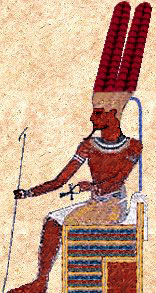
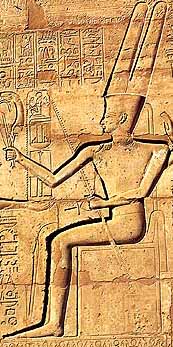
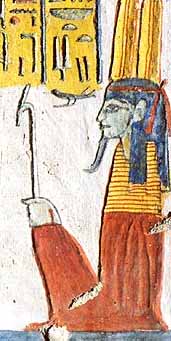
As he became more significant, he was paired with a goddess (his counterpart, Amunet, being the female aspect of the early concept of air, rather than a wife), and since he was becoming identified as a creator, it was considered more appropriate to designate him as the spouse of the divine mother from whom the cosmos emerged to enhance his status. By the time that Amun rose to this recognition, the divine mother was Mut. Amun became depicted in human form, seated on a throne, wearing on his head a plain, deep circlet from which rise two straight parallel plumes. The plumes may have been symbolic of the tail feathers of a bird, a reference to his earlier status as a wind deity.

Having become more important than Montu, the local war deity of Thebes, Montu's authority then diminished and he was said to be the son of Amun. As Mut then was said to be infertile, it was believed that she, and thus Amun, had adopted Montu instead of giving birth to him. This changed later when Montu was replaced by Khonsu, the lunar deity as her adopted son.


Rise of Cult after Expulsion of Hyksos

When the army of the founder of the Eighteenth dynasty expelled the Hyksos rulers from Egypt, the victor's city of origin, Thebes, became the most important city in Egypt, the capital of a new dynasty. The local patron deity of Thebes, Amun, therefore became nationally important. The pharaohs of that new dynasty attributed all their successful enterprises to Amun and they lavished much of their wealth and captured spoil on the construction of temples dedicated to Amun. The cultural advances achieved by the pharaohs of this dynasty brought Egypt into a cultural renaissance, restoring trade and advancing architectural design to a level that would not be achieved by any other culture for a thousand years.

As the Egyptians considered themselves oppressed during the period of the Hyksos rule, the victory accomplished by pharaohs worshiping Amun was seen as a champion of the less fortunate. Consequently, Amun was viewed as upholding the rights of justice for the poor. By aiding those who traveled in his name, he became the Protector of the road. Since he upheld Ma'at (truth, justice and goodness) - those who prayed to Amun were required, first, to demonstrate that they were worthy by confessing their sins.

Much later, because of the evidence of the adoration given to Amun in many regions during the height of his cult, Greek travelers to Egypt would report that Amun - who they determined to be the ruler of the Egyptian pantheon - was similar to the leader of the Classical Greek pantheon, Zeus, and therefore they became identified by the Greeks as the same deity. Likewise, Amun's consort Mut became associated by these Greeks with Zeus's consort in the Classical pantheon, Hera.

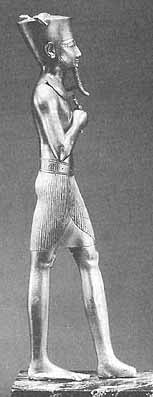
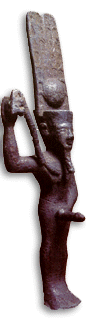
In the Greek period (and somewhat earlier, in order to ascribe many attributes to Amun-Re, he was sometimes depicted in bronze with the bearded head of a man, the body of a beetle with the wings of a hawk, the legs of a man and the toes and claws of a lion. He was further provided with four hands and arms and four wings.


The worship surrounding Amun, and later, Amun-Re represented one of ancient Egypt's most complex theologies. In his most mature form, Amun-Re became a hidden, secret god. In fact, his name (Imn), or at lest the name by which the ancient Egyptians called him, means "the hidden one" or "the secret one" (though there has been speculation that his name is derived from the Libyan word for water, aman. However, modern context seems to negate this possibility). In reality, however, and according to mythology, both his name and physical appearance were unknown, thus indicating his unknowable essence.

Stated differently, Amun was unknown because he represented absolute holiness, and in this regard, he was different then any other Egyptian deity. So holy was he that he remained independent of the created universe. He was associated with the air as an invisible force, which facilitated his growth as a supreme deity. He was the Egyptian creator deity par excellence, and according to Egyptian myth, was self-created. It was believed that he could regenerate himself by becoming a snake and shedding his skin. At the same time, he remained apart from creation, totally different from it, and fully independent from it.


However, while hidden, the addition to his name of "Re" revealed the god to humanity. Re was the common Egyptian term for the sun, thus making him visible. Hence, Amun-Re combined within himself the two opposites of divinity, the hidden and the revealed. As Amun, he was secret, hidden and mysterious, but as Re, he was visible and revealed. In some respects, this even relates to his association with Ma'at, the Egyptian concept of order and balance, and reflects back upon the ancient Egyptian's concepts of duality.

The secret, or hidden attribute of Amun enabled him to be easily synchronized and associated with other deities. At Thebes, Amun was first identified with Montu, but soon replaced him as the city's protector. His association with Re grew in importance when Amenemhet I moved the capital of Egypt to Itjtawy at the apex of the Nile Delta, where the relationship was probably expedient both theologically and politically. However, this association with Re actually grew as Thebes itself gained importance. Soon, Amun was identified with other gods as well, taking on the names (among others) Amun-Re-Atum, Amun-Re-Montu, Amun-Re-Horakhty and Min-Amun. However, it should be noted that with all of this synchronization, Amun was not absorbed to create a a new god. Instead, there was a unity of divine power with these other gods.


Amun-Re was associated with the Egyptian monarchy, and theoretically, rather than threatening the pharaoh's power, the throne was supported by Amun-Re. The ancient theology made Amun-Re the physical father of the king. Hence, the Pharaoh and Amun-Re enjoyed a symbiotic relationship, with the king deriving power from Amun-Re. In return, the king supported the temples and the worship of Amun. In theory, Amun-Re could even take the form of the king in order to impregnate the chief royal wife with the successor to the throne (first documented during the reign of Hatshepsut during the New Kingdom). Furthermore, according to official state theology during the New Kingdom, Egypt was actually ruled by Amun-Re through the pharaohs, with the god revealing his will through oracles.

In reality, the god did in fact threaten the monarchy, for the cult of Amun-Re became so powerful that its priesthood grew very large and influential, and at one point, priests of the deity actually came to rule Egypt during the 21st Dynasty. At other times, Amun-Re created difficulties for the king, such as in the case of Akhenaten, who sought to change the basic structure of Egyptian religion. In this instance, Amun-Re eventually proved more powerful then the king, for though Akhenaten desperately tried to change the nature of Egyptian religion, for such efforts he himself became the scorn of later pharaohs. After Akhenaten's reign, Egyptian religion almost immediately reverted back to its prior form and to the worship of Amun-Re.


Fertility God

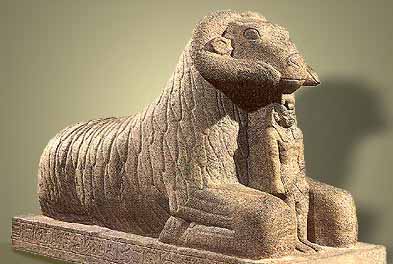
Subsequently, when Egypt conquered Kush, they identified the chief deity of the Kushites as Amun. This Kush deity was depicted as ram-headed, more specifically a woolly ram with curved horns so Amun became associated with the ram. Indeed, due to the aged appearance of the Kush ram deity, the Egyptians came to believe that this image had been the original form of Amun and, that Kush was where he had been born.

Since rams were considered a symbol of virility due to their rutting behavior, Amun also became thought of as a fertility deity, and so started to absorb the identity of Min, becoming Amun-Min. This association with virility led to Amun-Min gaining the epithet Kamutef, meaning Bull of his mother, in which form he was found depicted on the walls of Karnak, ithyphallic, and with a scourge, as Min was.

As the cult of Amun grew in importance, Amun became identified with the chief deity who was worshipped in other areas during that period, Ra-Herakhty, the merged identities of Ra, and Horus. This identification led to another merger of identities, with Amun becoming Amun-Ra. In the Hymn to Amen-Ra he is described as "Lord of truth, father of the Gods, maker of men, creator of all animals, Lord of things that are, creator of the staff of life." By then Ra had been described as the father of Shu, Tefnut, and the remainder of the Ennead, so Amun-Ra likewise, became identified as their father.

Ra-Herakhty had been a solar deity and this nature became ascribed to Amun-Ra as well, Amun becoming considered the hidden aspect of the sun during the night, in contrast to Ra-Herakhty as the visible aspect during the day. Amun clearly meant the one who is hidden. This complexity over the sun led to a gradual movement toward the support of a more pure form of deity.

During the later part of the eighteenth dynasty, the pharaoh Akhenaten (also known as Amenhotep IV) disliked the power of the temple of Amun and advanced the worship of the Aten, a deity whose power was manifested in the sun disk, both literally and symbolically. He defaced the symbols of many of the old deities and based his religious practices upon the deity, the Aten. He moved his capitol away from Thebes, but this abrupt change was very unpopular with the priests of Amun, who now found themselves without any of their former power. The religion of Egypt was inexorably tied to the leadership of the country, the pharaoh being the leader of both. The pharaoh was the highest priest in the temple of the capital and the next lower level of religious leaders were important advisers to the pharaoh, many being administrators of the bureaucracy that ran the country.

When Akhenaten died, the priests of Amun reasserted themselves. His name was struck from Egyptian records, all of his religious and governmental changes were undone, and the capitol was returned to Thebes. The return to the previous capital and its patron deity was accomplished so swiftly that it seemed this almost monotheistic cult and its governmental reforms had never existed. Worship of the Aten ceased and worship of Amun-Ra was restored. The priests of Amun even persuaded his young son, Tutankhaten, whose name meant "the living image of Aten" - and who later would become a pharaoh - to change his name to Tutankhamun, "the living image of Amun".

http://www.crystalinks.com/amun.html


Mut

MutMut

Mut (Maut, Mwt) was the mother goddess of Thebes (Waset, in the 4th Nome of Upper Egypt). The ancient Egyptians considered the vulture to be a protecting and nurturing mother, and so their word for mother was also the word for a vulture, "Mwt".

19th Dynasty statue of Mut

She was either depicted as a woman, sometimes with wings, or a vulture, usually wearing the crowns of royalty - she was often shown wearing the double crown of Egypt or the vulture headdress of the New Kingdom queens. Occasionally she was depicted as a male, in part because she was "Mut, Who Giveth Birth, But Was Herself Not Born of Any", and in part due to the superstitious belief that there were in fact no male griffon vultures (the male is almost identical in appearance to the female). In later times she was shown as woman with the head of a lioness, a cow or a cobra as she took on the attributes of the other Egyptian goddesses.


Mut replaced Amun's earlier wife, Amanuet (the invisible goddess) during the middle Kingdom. Mut was believed to have existed since primeval times, existing along side Nun, the primeval waters (possibly because she replaced Amaunet who was one of the ancient gods of the Ogdoad- the great eight - who lived in the waters). She was initially worshipped as a local deity, but rose to prominence as the queen of the gods when her husband, Amun, became the foremost national god during the New Kingdom. Thebes became the capital of Egypt, and the Theban gods became the national gods. As a result, Mut was also closely associated with the queen, the mother of the nation. She was particularly popular with the queens of theEighteenth and Nineteenth dynasties, most notably the Pharaoh Hatshepsut and Nefertari Merytnmut ("Nefertari, Beloved of Mut") the Chief wife of Ramessess II.

When her husband Amun merged with the sun god Ra, as Amun-Ra, Mut inherited the title the "Eye of Ra" (a title also associated with Sekhmet, Hathor, Tefnut, Bast and Wadjet, amongst others). The "Eye of Ra" was the daughter of Ra in the form of a lion who embodied the fierce heat of the sun. However, Mut was also "Mother of the Sun in Whom He Rises" - making her both the mother and daughter of the sun god. Originally Montu (the Theban god of war) was considered to be their son, but he was replaced by Khonsu (the moon god). The Theban triad of Amun, Mut and Khonsu were worshipped at the Temple of Amun at Luxor (Ipet-Resyt). Although her worship centred around Thebes, she was also worshiped in Djannet (Tanis), Zau (Sais), the Oases of Kharga and Dakhla.


Mut was also closely associated with a number of other goddesses such as Isis and Nut, and was worshipped as a member of a number of composite deities. With Isis and Nekhbet she formed the deity called "Mut-Isis-Nekhbet, the Great Mother and Lady". She was a winged goddess with leonine feet, an erect penis and three heads (the head of a lioness wearing Min´s double plumed headdress, the head of a woman wearing the double crown of Egypt and the head of a vulture wearing the red crown of Lower Egypt). With Bast and Sekhmet she was Sekhmet-Bast-Ra, another three headed deity (the head of a lion with a plumed headdress, a woman wearing the double crown and a vulture wearing the double plume headdress). In this form she is described in the Book of the Dead protecting the dead from being disturbed. She was also worshipped as Mut-Wadjet-Bast, Mut-Temt, and Mut-Sekhmet-Bast-Menhet.

Mut with RamessesII and Amun copyright http://www.flickr.com/photos/robven/

During the New Kingdom, one of the most popular holidays was the Festival of Mut in Thebes. A statue of the goddess was placed on a barque and sailed around the "Isheru" (the small crescent moon shaped sacred lake at her temple at Karnak). There was also a celebration during the New Year festival when the statue of Amun traveled from his temple at Luxor down to Karnak to visit her. Originally this was for the fertility goddess Opet (possibly an aspect of Taweret), as a way of ensuring fertility for the coming year.

The temple, "Hwt-Mwt" ("the estate of Mut") was situated to the south of the great temple of Amen-Ra, with an avenue of sphinxes approaching it. She was worshiped there as "Mut, the Great Lady of Isheru, the Lady of Heaven, the Queen of the Gods". Strangely, there are few representations of her in her vulture form in this temple. However, there are numerous depictions of her as Sekhmet, the "Eye of Ra" - a number of which seem to have been transported from Amenhotep III´s funerary temple on the west bank. It is thought that the temple was initially established by Hatshepsut and Thuthmose III, and then expanded by Seti I, Ramesses II, Ramesses III and King Tarqa (25th Dynasty). She was worshipped up until the Roman period, when her temple fell into disrepair.

http://www.ancientegyptonline.co.uk/mut.html

Reposted for the purpose of reviews, under: U.S. Fair Use and Canadian Fair Dealing 29.1 and 29.2


"Search" page.  Type in a keyword or a sentence, search in:
keywords and Titles  or keywords and in Full Text
   Display title, Id#
... hold fast what is good. (1 Thes. 5:21) ...
"Index" page:   
... The Logos-Wisdom ...
"... The Logos-Wisdom is the principle of all Divine and Esoteric Revelations. She has the characteristics of being the indwelling revealer of God.
She IS the active principle and the transmitter of all Divine knowledge as well as the Cosmological cause of all Creation ..."
Contact |  Disclaimer

Luke 6:31(NIV); " Do to others as you would have them do to you. " ...


Translate | Übersetzen | Traduire | Tradurre | Traduzir | Traducir | ترجم | অনুবাদ | 翻譯 | Переведите | Tłumaczyć | 翻訳します | 옮기다 |
fordít | Traduceți | Çeviri yapmak

Go Back

" Higher and Lower Psychism ""